Blue Goose | Mr Christian
The Blue Goose Story
SYDNEY shipwright Gavin Clark took the phone call from one of his clients, a local businessman and serial boatowner, asking him to inspect a boat he had seen advertised for sale.
“Next thing I know I’m in a place called , funnily enough, Sydney on Vancouver Island on the Canadian West Coast looking at an old boat sitting on drums in a paddock”.
But the old boat, Blue Goose, was a thing of beauty and after Gavin reported that she wasn’t in bad shape the businessman decided to buy her and bring her to Australia for restoration for use as a dayboat on Sydney Harbour. Gavin’s company, Slipstream Marine, operates from a slipway in Sydney’s Eastern suburbs, too small for a project like this, so a large shed was found.
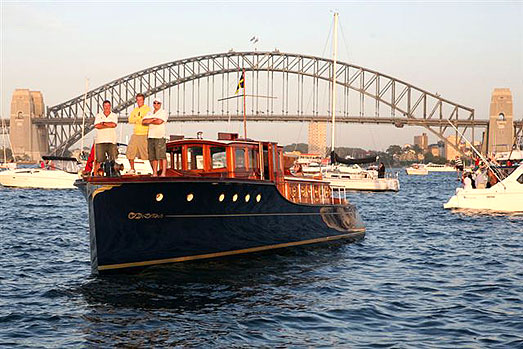
Blue Goose had been built in 1927 by a famous Californian yard, Fellows and Stewart of Los Angeles, for Mr. E. T. Wall who owned the Blue Goose orchards in LA.
Lloyds’ Register shows that the 50-footer had a waterline of 49ft 4in, beam of11ft and 2ft 9in draught. Power was by two six-cylinder petrol Kermaths, though research shows she may have had 175 Stirling Coast Guard engines.
She was designed as a commuter, intended to ferry the owner to work and home again, a role reflected by her interior layout. The only cockpit is the small one in the stern.
Research also shows she was requisitioned during World War II for coastal patrols off Los Angeles. It is believed that she had only four or five owners. “The last owner came to grief during her restoration, which is why she ended up in the yard where we found her”, says Gavin.
When she arrived in Sydney and set up in a shed the stern sections were found to have twisted during her time stored on drums, but she was in surprisingly good shape. Gavin and the owner agreed that they wanted to change as little as possible. Topsides, superstructure and the interior were in excellent condition, so the aim was to renovate rather than restore.
Keel and frames are of American oak, planking in Douglas Fir. Gavin believes the planking was originally about 1 1/8inches thick but after almost 80 years of maintenance the planks were down to about 7/8in. Gavin recommended that the best course of action was to sheathe the hull in fibreglass, a decision which caused a lot of muttering on Sydney’s waterfront. No less a personage than former Australian Prime Minister Paul Keating weighed in on the debate. Keating has an eye for antiques and for old boats; he is credited with finding the 128ft Cambria derelict in Australian waters. 7and Cambria’s owners sheathed her hull which later caused consternation among the Northern Hemisphere classic boat set. Keating told Gavin that as a purist he did not agree with sheathing the Goose.
Gavin went ahead with sheathing because re-planking was not economically feasible. “Our only other option was to put on a double diagonal veneer, which uses more epoxy than sheathing, anyway. “ Blue Goose is the fourth craft Gavin has sheathed, including Archina, a 1906 Fife yacht which was sheathed in 1998 and, according to Gavin, looks as good as the day she left the yard.
So the 40 damaged planks were replaced by oregon. The topsides were already splined, and planking below the waterline was caulked with linseed putty and cotton. Blue Goose had been restored during the 1990s when damaged frames had been replaced and she had been refastened with bronze screws. The team used extra fastenings in the stern after the twist had been straightened.
When the hull was faired, on went a layer of 440 gram double bias fibreglass cloth in epoxy resin. She was filled and faired and painted with Awlgrip. The decks were in good condition, and had only to be recaulked with Sikaflex. The forward and aft coverboards were lifted and re-bedded. I noticed that in the cockpit aft the the team left the Sikaflex unscraped, to protect the teak, until the boat was ready to launch.
BUT this story is getting ahead of itself. While work on the hull was proceeding the wheelhouse roof was removed so the power units, twin Chrysler Hemi V8 petrol V8s, could be lifted out.
“We looked around for suitable 165hp units for the repower, and talked with Volvo who came up two 185hp D4s which they figured should give us 17 knots, her former top speed, says Gavin. “And,” he laughs, “we got there”. Top speed is 17.2 knots at 2950 rpm.
Not that she will do that often. She will cruise Sydney harbour at 8-10 knots and those on board will “eat cucumber sandwiches and drink Bloody Marys”.
Because the Goose had to look as original as possible the original engine controls were retained, connected to the Volvo Penta diesels’ electronic controls in the engineroom.
The interior was stripped of all finish and the few changes were made using Brazilian mahogany, sourced from local yards, as no Honduras mahogany could be found. Gavin lists finding the mahogany as his biggest problem of the restoration. The timbers were stained and colours matched, then hand-brushed with a satin varnish.
The portholes had been gold-plated by the previous owner, so that was redone. “All the brasswork was polished and sealed. Some of the old brass was pitted, but that was left.
“The owner wanted the boat to look its age, to look like a 1927 boat”, says Gavin. “People ask why didn’t we do this, why didn’t we do that, but my idea is to keep it as original as possible. If the timber has a big gouge, you keep it. “
The prop shafts were re-used and so were the rudders. The props too were retained as they had been upgraded to four-bladers during the previous refit. Local experts Porters tweaked them to suit the new motors. “We kept the old bevel-gear steering but we may have to go to hydraulic in the future as the steering loads up a bit when turning to starboard at high revs.”
The anchor winch is the 1927 original. It may have been hydraulic at some time but had been converted to electric. The former owner and the Los Angeles Maritime Museum tracked down the original builders’ plate which now sits ahead of the wheel.
After the engines had been set up, the team decided to fit Python drives (like big universal joints, says Gavin) which contribute to the remarkable smoothess of the finished boat.
Gavin believes the owner’s cabin and en suite head was forward, but think it is more like to have been the skipper’s quarters. The bigger cabin, surely the one preferred by the owner, is aft. On the starboard side aft, the area that used to be the second toilet has been converted to a bar and servery. Opposite that is a galley which originally had pot belly stove and an old fridge. As this is a dayboat she has been fitted only with a microwave, hidden from sight.
Further aft on the starboard side is the dressing room with a full-length mirror. “This is where Mr. Wall would have sat reading the LA Times and drinking his coffee,” Gavin suggests. Right aft the cabin is fitted with a large bed, not quite a double in width.
The electronics are hidden in the engineroom. There are no extras like depth sounders.
Does Gavin have any regrets? “It is hard to have regrets on a project like this, it is something to be proud of.
“The team pulled trogether the boys got a really big bang out of it, working with chief shipwright Graham Fauls who drove the project.
“We had two apprentices, one in his first year and he has picked up more during this job than he will pick up in the next couple of years.
“The other apprentice is nearing the end of his time and for him it couldn’t have been better timed as it has enabled him to hone all his skills”.
I ask the younger apprentice how he felt about the job. “I love it, it’s real boatbuilding”, he says. So wooden boats are not only about nostalgia.
After nine months of work Blue Goose was loaded up for launching. As she came out of the shed a shipwright working on another project looked dubious, saying he would have preferred full restoration rather than leaving some details as found.
Later in the day, at her launching from a yard just west of the Sydney Harbour Bridge, a well-known restorer of old boats admired the work on Blue Goose but said he had reservations about the durability of a sheathed hull. This shipwright was working in the yard on the raised-decker Maluka, the 30ft Ranger class built in 1932 which was being prepared for the 2006 Rolex Sydney-Hobart race. The team had sheathed Maluka for the rough race south; she finished 63 rd of the 69 finishers, eighth on handicap.
And to add to the discussion Koomooloo, the planked 42ft classic of Australian ocean racing, was lost during the race, and the cold-moulded Love & War, dating from 1973, won on handicap.
IN BLUE GOOSE’s wheelhouse instrumentation is limited to the basic engine systems and they are hidden by a folding timber cover when the boat is at rest.
The Volvo diesels are pleasantly quiet. Gavin opens the throttles and Blue Goose raises her nose a little as she accelerates, then she happily slices the water of Sydney Harbour on a morning when we seem to have the waterway to ourselves; not even the ferries are intruding. On a day like this, if you use your imagination the treed stretches of the harbour foreshores look much as they did when Captain Arthur Phillip saw them as the First Fleet sailed through the Heads in 1788.
What I love about narrow, round-bilge boats is the way they move, cleaving the water instead of crashing into and over it, sliding forward with little effort and a civilised motion. Blue Goose runs up to her top speed, the nose having lifted only a few degrees from her static trim so visibility is unaffrected. While Gavin drives I sit back in one of the two small seats at the aft end of the wheelhouse and we are kings of the harbour.
I ask Gavin if the owner was happy with the result. “On our first run we had Frank Sinatra playing on the sound system and as we came back to the mooring he gave me a big hug and said, “ ‘ We are very very lucky, we have gone back in time. It’s a privilege’ ”.


|